Mising Flood Resilience: Traditional Wisdom in Assam
Balancing modern engineering and Mising wisdom in flood-prone Assam.
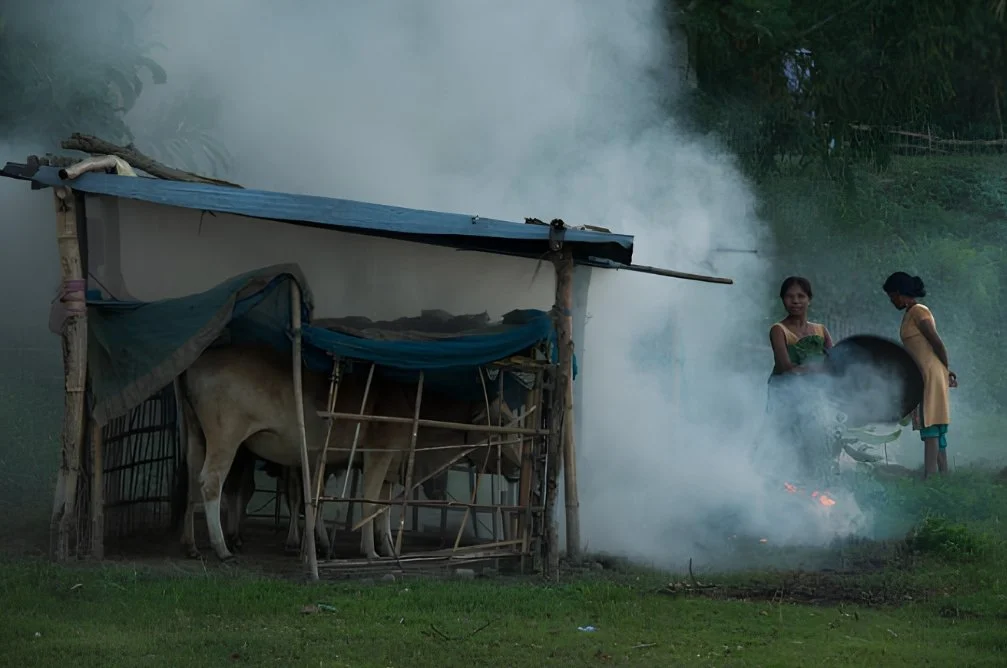
The 2026 floods in Assam have rewritten the rules for the monsoon season and its survival along the Brahmaputra river. Between June and August 2026, widespread flooding was triggered by heavy rains and huge rushes of water from the hills in Arunachal Pradesh and Nagaland. While the expensive modern dams and walls failed, the time tested survival secrets of the Traditional Ecological Knowledge( TEK) were also tested to their absolute limits. According to state disaster reports, the deluge claimed 107 lives and displaced over 500,000 residents. The floodwaters tore through the roads and submerged more than 24,897 hectares of cropland. Data from World Weather Attribution highlights that while rain was the catalyst, a heavy reliance on rigid concrete embankments worsened the crisis by trapping water inside villages when breaches occurred. Yet, as modern engineering struggles to adapt, looking to the traditional ecological knowledge (TEK) of the indigenous Mising community reveals a more nuanced story.
“This time-tested wisdom is neither a straightforward cure for all the problem nor is an outdated “backward” knowledge relic; instead, it is a living, resilient strategy facing unprecedented modern pressures.”
The Braided lives of Mising & the Brahmaputra.
The Mising tribe is the second largest indigenous group living on the plains of Assam. They migrated from the eastern Himalayas in Arunachal Pradesh to settle along the dynamic plains of the Brahmaputra. For generations, their relationship with the river has been deeply symbiotic, rather than viewing the Brahmaputra as an adversary to block out, the Mising see it as a natural neighbor. The name “Mising” literally translates to “river people”- mi means man, and asi means water/river.
Their customs, songs and daily routines mirror the river’s seasonal pulse, recognising that the yearly floods wash clean the earth and leave behind nutrient rich silt for farming. Today, however, that partnership is being pushed to its limits. Deforestation, upstream dams, and sand mining have made the Brahmaputra lot more unpredictable, replacing the gentle seasonal rises with flash flood surges. WIth this changing landscape, we need a more careful blend of what both the Mising ecological knowledge and modern tools have to offer.
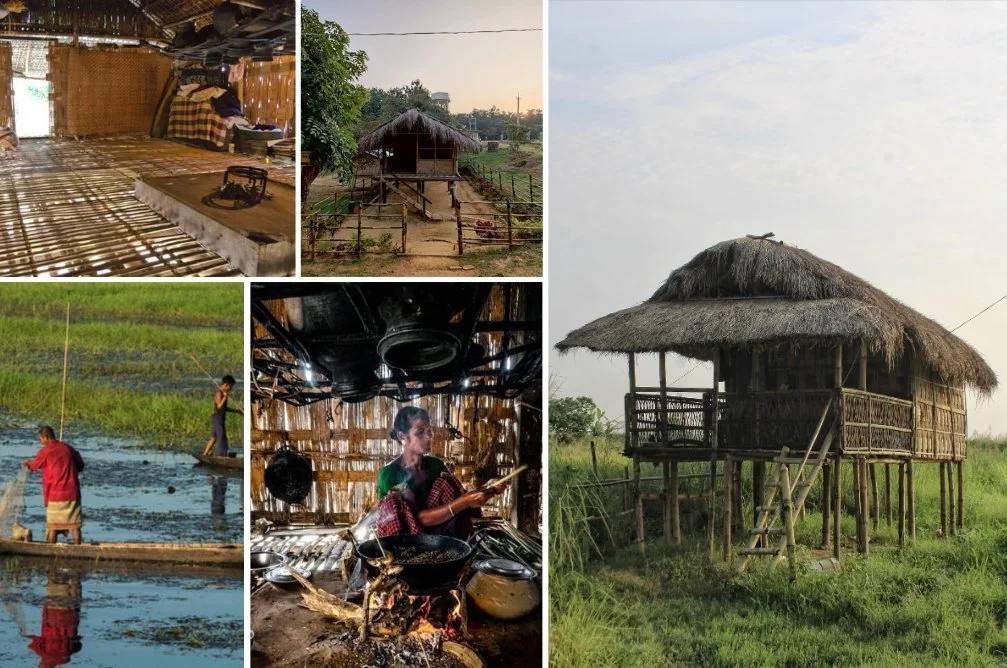
The Chang Ghar from inside and out.
Traditional Ecological Knowledge
The best example of their smart thinking is the Chang Ghar, which is a house built on stilts about 5 to 10 ft off the ground. This architecture technique uses the following principles.
Measuring the water levels: They look at the old marks on the trees from past floods.Using that information, they alter the height of the stilts every water cycle.
Aerodynamic design: The bamboo walls and floors have tiny gaps in them. This lets cool air pass through and stop strong flood currents or heavy winds from knocking the house down.
The Meram (the fireplace): The middle of the house comprises a clay fireplace. Hanging directly above the fire are bamboo shelves.The smoke and heat from cooking keeps farming seeds safe from mold and dampness during the rainy season.
Lego-Like Houses: The houses are built out of light bamboo, grass and ropes instead of heavy bricks and metal nails. If the river bank starts crumbling under their village, they can take the whole house apart in a few days, load them onto boats and rebuild it in a safe spot.
Use of local bio-material: A special thick bamboo called Bhaluka is used as the primary construction material. It is incredibly bendy, allowing it to wobble in a strong river current without snapping into pieces.
Similarly, the Mising integrated the fluid schedules within their agricultural practices for centuries. They plant a deepwater paddy variety called Bao Dhan (Bao rice), a longer variety of rice using loathing seedbeds that adapts to the water levels making it resilient even during flood like situations. They integrate this pattern into their culture by celebrating a big spring festival , Ali-Aye-Ligang, when it’s time to plant, keeping their entire community in sync with the seasons.
What is shifting and how can it be adapted?
In 2026, some water levels climbed way past the prediction, thereby spilling into elevated living areas. Instead of giving up on the design, many families are actively innovating. Where resources are all they are integrating concrete pillars with flexible bamboo framing, raising their platforms even higher to meet the new baselines.
Recent unseasonal flash floods caught many fields unprepared, while heavy sand deposits impacted temporarily the soil quality. This setback highlights a gap, while traditional seeds are resilient, farmers need to have access to real-time localised climate forecasts to time their planting accurately.
The Danger of ignoring time tested traditional ecological knowledge (TEK).
For a long time, the government has tried to solve floods by building giant dirt walls, concrete blocks and dropping heavy sand bags. The traditional ecological knowledge of the Mising way of life is treated as a primitive and not scientific approach. Conventional infrastructure like concrete walls, drainage systems give people false sense of security. They are not capable of adapting to the dynamic nature of the river and water cycles. This topped with construction of brick , concrete houses within the flood plains and along the walls eventually crack and fail during unforeseen situations. By ignoring the Mising, we are losing valuable secrets. They know how to read the river’s currents, and which birds nest early when a big storm is coming. Forcing them into modern concrete camps makes us lose this life-saving knowledge.
From Tokenism to Teamwork: Co-designing the Future.
If we want to survive future floods, we need to stop treating indigenous communities like the Mising like helpless victims. They need to be co-designers and pioneers in new flood safety laws, not just people who receive relief blankets.
Giving Elders a say. Government safety teams need to sit down with Mising village elders. The main gap that needs to be first tackled before doing this, is to
“Recognise the Mising as not just passive data sources, but “vital partners” in reshaping Assam’s Landscape.”
True integration means moving past romanticized appreciation and focusing on practical co-design. When government agencies like the Assam State Disaster Management Authority collaborate with local village councils (Mising Banne Kebang):
Long-term resilience and growth can happen
Upgrading the architecture to be resilient to the current and future flood patterns:
Modern flood barriers can be designed to mimic natural wetlands
Public buildings like schools and health centres can adopt the raised, stilt based blueprint of the Chang ghar using durable, eco-friendly materials.
Groups like SEEDS have worked with Mising to create hybrid stilt houses.
Hands in Mud: How travellers can actively support riverbank reforestation in Assam?
Mass tourism acts as an extractive force in fragile environments. It relies on building heavy , permanent infrastructure- like concrete resorts, parking lots etc. This disrupts natural drainage, strips away the soil binding vegetation, and leaves behind plastic waste. Furthermore, the financial profits from the business establishments, especially large resorts rarely reach the indigenous population, instead, locals are often confined to low-wage service jobs while their culture is treated as a passive performance for the cameras.
On the famous river islands of Majuli, local travel agencies like ChaloHoppo are helping tourists stay in the Chang Chars. The money goes directly to local families to help them fix and keep up their houses.
To truly understand the floodplains of the Brahmaputra, a traveller must step off the viewing deck and move directly into the muddy eroding bank of the river. When travelers join a community-led restoration initiative on a chapori (river island), they do not just plant trees at random. They follow a strict, scientifically backed traditional planting structure designed by the Mising communities.
As the 2026 floods proved, the original chang ghar and the farming techniques can only do so much of the land beneath is being eroded by violent currents. Mass tourism ignores this erosion. But if we change this by inviting the travelers to become active participants in ecological repair under the guidance of the Mising communities can act as a catalyst to native riverbank-reforestation projects. When travellers from all over the world show respect to this knowledge and way of living, it makes the younger generations of the communities proud of their roots and promote keeping the wisdom alive. Turning travel into an active investment in climate adaptation, helps challenge and transform world wide narrative and outlook.
References:
Assam State Disaster Management Authority (ASDMA) (2026) Disaster Reporting and Information Management System (DRIMS) Daily Report. Available at: assam.gov.in.
Babushahi (2026) Assam flood toll rises to 105; nearly 32,000 people still affected. Available at: babushahi.com .
Borah, R. (2026) 'Assam's Mising Tribe: Indigenous Climate Wisdom and Living in Harmony with Floods', Down To Earth, 8 August. Available at: downtoearth.org.in .
Chetry, S. (2024) 'Between Floods and Climate Change: Revisiting the Mishing Community of Majuli Island, Northeast India', ResearchGate, Technical Report. doi:10.13140/RG.2.2.32144.38402.
Coverfox (2026) Assam Floods 2026: Death Toll, Damage, Causes and Latest Updates. Available at: coverfox.com.
Deutsche Welle (2025) India's Chang Ghar traditional homes are resilient to floods, DW Video News, 17 September. Available at: dw.com .
Dialogue Earth (2021) Stilt houses help people withstand floods in Assam. Available at: dialogue.earth .
Global Voices (2022) India’s Mising tribe lives in traditional flood-resilient homes to adapt to climate change. Available at: globalvoices.org .
Indulgexpress (2026) 'What is a Chang Ghar? Assam's unique stilt houses', The New Indian Express Group, 7 July. Available at: indulgexpress.com.
Mahabahu (2026) Mising Indigenous Governance and Hydrological Resilience in the Brahmaputra Basin, 11 June. Available at: mahabahu.com.
Mongabay India (2023) How Assam's Mising community is coping with floods through architectural design. Available at: mongabay.com.
Reasons to be Cheerful (2025) The Modern Makeover of Assam's Centuries-Old Stilt Houses. Available at: reasonstobecheerful.world.
ReliefWeb (2026) Situation Report 2 - Flood Situation in Assam and Mizoram (Date: 18th July 2026). Available at: reliefweb.int .
Springer (2026) 'Assessing flood vulnerability in the Brahmaputra Valley of Assam', Environmental Monitoring and Assessment, 20 June. doi:10.1007/s44274-026-00830-0.
UNDRR (2021) India's Mising community seeks to expand its indigenous adaptation practices in response to climate change. United Nations Office for Disaster Risk Reduction. Available at: undrr.org .
World Weather Attribution (2026) Flood impacts in Assam driven by high exposure and structural vulnerability amid uncertain rainfall trends, Empirical Climate Assessment, 14 August. Available at: worldweatherattribution.org.